

If you've ever tackled a multi-level floor install-whether it's in a home with a bedroom over a basement, a small commercial space with an office loft, or even a rental property with split-level flooring-you've probably run into that awkward gap between floors that's too high for a regular transition strip, or too uneven to just shove a carpet edge into. As a supplier of Aluminum Floor Carpet Trim, I get a ton of questions from contractors, homeowners, and property managers: does this stuff actually work on multi-level floors? The short answer is yes, but only if you pick the right type, install it correctly, and account for a few key differences between floor levels. Let's break this down like I would over a coffee with a customer-no fancy jargon, just real-world stuff that's saved my team from a lot of callback jobs.
First, let's get clear on what a multi-level floor actually is, because a lot of people mix this up. Multi-level doesn't just mean one floor is 1/4 inch higher than the other-think, say, a hardwood main floor and a carpeted upper landing that's 3/4 inch higher, or a concrete garage floor and a carpeted mudroom entry that's 1 inch lower. That height difference is the big make-or-break here, and it's where generic transition strips fail. Your basic plastic transition strip can handle up to like 1/2 inch, but aluminum trim is way more flexible for bigger gaps. That's why Aluminum Carpet Transition Strip is such a workhorse for these jobs-its metal core can span those uneven height differences without bending or warping, which is a huge upgrade from plastic or wood alternatives.
Wait, but let's talk about why aluminum is better for multi-level floors specifically. Wood trim might look nice, but it swells and shrinks with humidity-so if your upper floor is in a bathroom addition (super common multi-level setup) where humidity spikes, that wood trim will warp and leave gaps that catch dust or trip people. Plastic is cheap, but it gets brittle over time, especially in sunlit areas like a second-floor patio enclosure. Aluminum? It's moisture-resistant, stable in temperature changes, and strong enough to hold carpet edges and cover height gaps without sagging. I've had a guy install a 1.2-inch height difference between his basement concrete (finished with polished concrete) and his upstairs carpeted game room-used Z Strip Carpet Transition trim, which is a type of aluminum floor carpet trim, and it's still holding 5 years later, no issues. That's not something a plastic strip would do.
Now, here's where most people mess up with multi-level floors: not accounting for the direction of the height difference. Let's say your lower floor is tile, upper is carpet-you need trim that covers the edge of the carpet and sits securely on the tile side. If it's the other way around (lower carpet, upper tile), you need something that tucks under the tile edge. That's where specific aluminum trim types come in. For a multi-level setup where the carpet is on the upper, higher level, a Carpet Aluminum Edge Trim works perfect-its narrow channel sits right under the carpet's edge, while the base plate spans the height gap to the lower floor. If the carpet is on the lower level and the upper is a hard surface, an Aluminum Carpet Edge Trim with a reverse lip (we call it a "drop lip" in the shop) tucks under the upper hard surface, so there's no trip hazard and no chance the carpet slides under the trim over time.
But let's get into the nitty-gritty of installation, because that's where aluminum floor carpet trim shines on multi-levels, but also where it can go wrong. First, measure the total height difference between the two floors-this is non-negotiable. If your gap is 7/8 inch, don't try to force a trim made for 1 inch; you'll end up with a gap between the trim and the lower floor that collects dirt. Most aluminum floor carpet trim is available in 1/2 to 1.5-inch height options, so you can match almost any residential multi-level gap. For commercial spaces, we can even cut custom heights, but for most homeowners, stock sizes work.
Next, prep is key. A lot of people just lay the trim on top of the two floors and glue it down, but that's a recipe for failure on multi-levels. You need to make sure both floor edges are straight and secure-no loose subfloor or soft carpet padding. For hard surfaces (tile, hardwood) on the lower level, screw the trim's base plate into the subfloor through the tile or wood, not just on top. For the carpet side, stretch the carpet tight so the edge doesn't pull away from the trim's channel-use a knee kicker to get tension, then tuck the edge into the trim's channel with a trim tool (we give these free with bulk orders, fyi). If you skip stretching the carpet, over time the padding will compress, and the carpet edge will sag, creating a trip hazard.
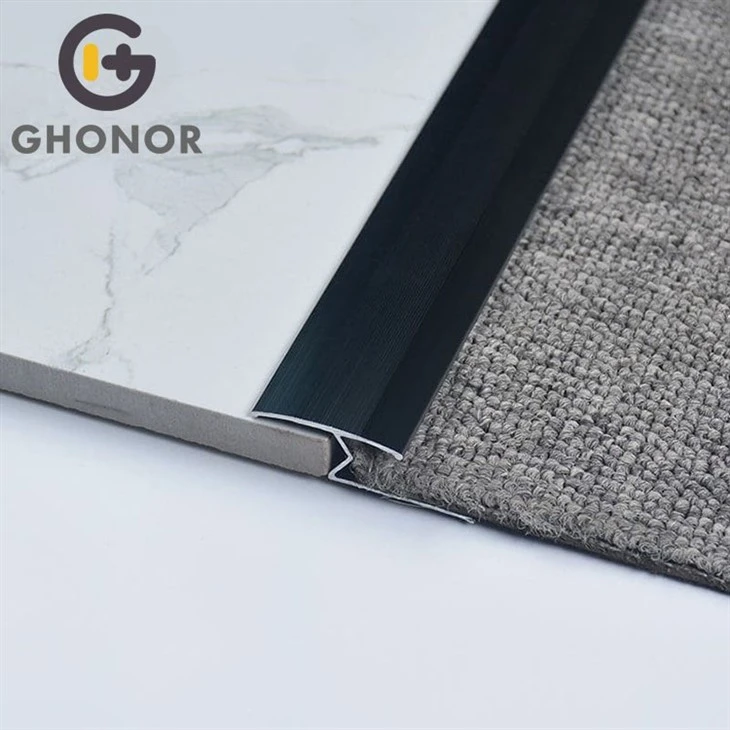

Wait, what about if your multi-level floor has a curved transition? Like a staircase landing that curves into a hallway? Aluminum trim bends easily-unlike wood, which snaps if you try to curve it, or plastic, which creases. That's a big one for multi-level homes with open layouts, where transitions aren't straight. I recently did a job for a homeowner with a curved landing between her first-floor living room (hardwood) and second-floor bedroom (carpet) - she ordered a roll of aluminum floor carpet trim (we sell some in 8-foot rolls, which you can cut or bend) and shaped it to the curve herself with a heat gun (low heat, don't melt it) - looked way better than a custom-cut wood trim would have, and it didn't warp in a year of high traffic.
But let's address the myth that aluminum trim is too expensive for multi-level floors. Yeah, it's a bit more than plastic, but think about the long-term cost. Plastic trims on multi-level gaps often crack after 2-3 years, requiring a callback. I've had customers tell me their cheap plastic trim broke and they had to rip out half the carpet to replace it-total cost like $300. Aluminum trim, installed right, lasts 10+ years, and you don't have to rip out carpet to replace it, since you can just unclip the old trim and snap a new one in (our newer aluminum trims have a snap-in design, not just glue). That's a huge time-saver for anyone doing a rental property, where turnover is high.
Wait, are there any downsides? Let's be honest-nothing's perfect. If you have a super uneven multi-level gap (like 2 inches, because someone installed the upper floor way too high), you might need two pieces of trim stacked, but that's rare in residential spaces. Also, if you're going for a ultra-sleek, modern look, aluminum might not match every hardwood or tile, but we have aluminum trim in brushed silver, bronze, and black finishes, so you can match most designs. We also make aluminum carpet transition strips that are thin enough for small gaps, but thick enough for heavy traffic-so it's adaptable, not a one-size-fits-all.
Let's use a real customer story to make this concrete (pun intended). Last month, a contractor named Mike hit me up because he was working on a split-level apartment complex where each unit had a 1-inch height difference between the lower kitchen (vinyl plank) and upper bedroom (carpet). He'd tried plastic trim before, and 3 out of 10 strips cracked within 6 months, leading to 15 callbacks. We sent him Aluminum Floor Carpet Trim in 1-inch height, and the snap-in style. He told me a week later that he's not had a single callback, and his customers are happier because there's no trip hazard. That's exactly why multi-level spaces benefit from aluminum trim- it's durable, easy to install, and saves you money in the long run.
Another thing to consider: accessibility. If your multi-level floor is in a public space, like a store or a library, ADA rules say transitions can't have a height difference more than 1/4 inch, but if you have a larger gap (which is common in old buildings), aluminum trim can be installed with a slope to meet ADA requirements. Most plastic trim can't be shaped into a gentle enough slope without buckling, but aluminum is rigid enough to hold a gradual slope, so you don't have to make sharp edges that could cause falls. That's a big plus for commercial multi-level jobs, where compliance is non-negotiable.
Wait, let's wrap this up so it's not just a list of facts- I want you to walk away knowing if aluminum floor carpet trim is right for your multi-level project, and how to pick the right one. First, measure your height gap: if it's between 1/2 and 1.5 inches, aluminum trim is perfect. Second, match the type: if carpet is lower, get a drop lip trim; if carpet is upper, get an edge trim that holds the carpet edge. Third, install correctly: prep the subfloor, stretch the carpet, screw the base plate (don't just glue) - that's the secret to no issues.
If you're not sure which trim fits your specific multi-level floor, just reach out. We don't do pushy sales stuff- I'll ask you for the height difference, what the floors are made of, and if you need a straight or curved transition, and point you to the exact trim. Whether you're a homeowner doing a bedroom update or a contractor working on a 10-unit apartment, we can help you pick the right aluminum floor carpet trim that works for your project. Don't waste time with flimsy plastic that'll break in a year-go with aluminum, which is built for the uneven, high-traffic spaces that come with multi-level floors.
If you have questions or want to order samples, feel free to reach out to our team to discuss your needs and place an order.
References:
- International Residential Code for Multi-Level Floors, 2021
- Flooring Transition Material Durability Study, National Wood Flooring Association, 2022
- ADA Accessibility Standards for Floor Transitions, U.S. Access Board, 2023
- Commercial Flooring Installation Best Practices, Carpet and Rug Institute, 2021