


How To Import Duty Free Tile Trim To Usa: a Practical Guide For Importers In 2026
Importing ceramic tile edge trims to the United States has become a challenging issue with diminishing profits. Due to the restrictions imposed by Section 232 aluminum and steel tariffs, Section 301 tariffs, as well as high anti-dumping and anti-subsidy taxes (AD/CVD), the seemingly profitable full-case goods on the factory quotation list often lose their competitive edge at the port of entry.
With the tightening of the "minimum" rule in the United States, the practice of splitting the goods into small packages to avoid customs inspections is no longer feasible.
However, "tax-free" or nearly zero-tariff imports are not impossible - the key lies in establishing a legal supply chain structure rather than relying on loopholes. In 2026, Some American building material distributors and contractors are reducing import costs by two main methods: one is to purchase aluminum profiles from compliant Southeast Asian production bases, and the other is to strategically select materials.
1. Understanding the Real Tariff Breakdown on Tile Trim
Before looking for ways to reduce duties, it helps to separate the standard Most Favored Nation (MFN) base rate from punitive trade remedies.
|
Material Category |
Typical US HTS Heading |
MFN Base Duty |
Key Additional Trade Remedies (If Made in China) |
|
Aluminum Profiles |
7604.21 / 7604.29 |
1.5% – 5.0% |
Section 232 tariffs + Section 301 + High AD/CVD rates |
|
Stainless Steel Profiles |
7222.40 / 7216.61 |
0% (Duty-Free) |
Section 232 steel tariffs + Section 301 |
|
Brass Profiles |
7407.21 |
1.5% – 3.0% |
Section 301 duties |
|
PVC / Plastic Profiles |
3916.20 |
5.8% |
Section 301 duties |
Two things stand out immediately from this breakdown:
Aluminum carries the heaviest burden when sourced from China, primarily due to overlapping AD/CVD orders on aluminum extrusions.
Certain stainless steel profiles carry a 0% MFN base rate, making material choice just as important as country of origin.
2. Purchase aluminium tile trims from Cambodia and Vietnam (limited to aluminium facilities)
For importers who purchase large quantities of anodized or brushed aluminium tile trims, moving production to regions outside of China is the most direct way to avoid AD/CVD tariffs and Section 301 tariffs. However, the U.S. Customs and Border Protection (CBP) conducts strict inspections of goods from Southeast Asia to detect illegal re-shipment activities - that is, goods are transported through a third country and then relabeled.
To meet the requirements of legal non-Chinese origin, the products must undergo significant processing and transformation in the exporting country.
At Ghonor, our production base in Southeast Asia focuses on dedicated aluminium production, rather than relying on trade-based alternatives:
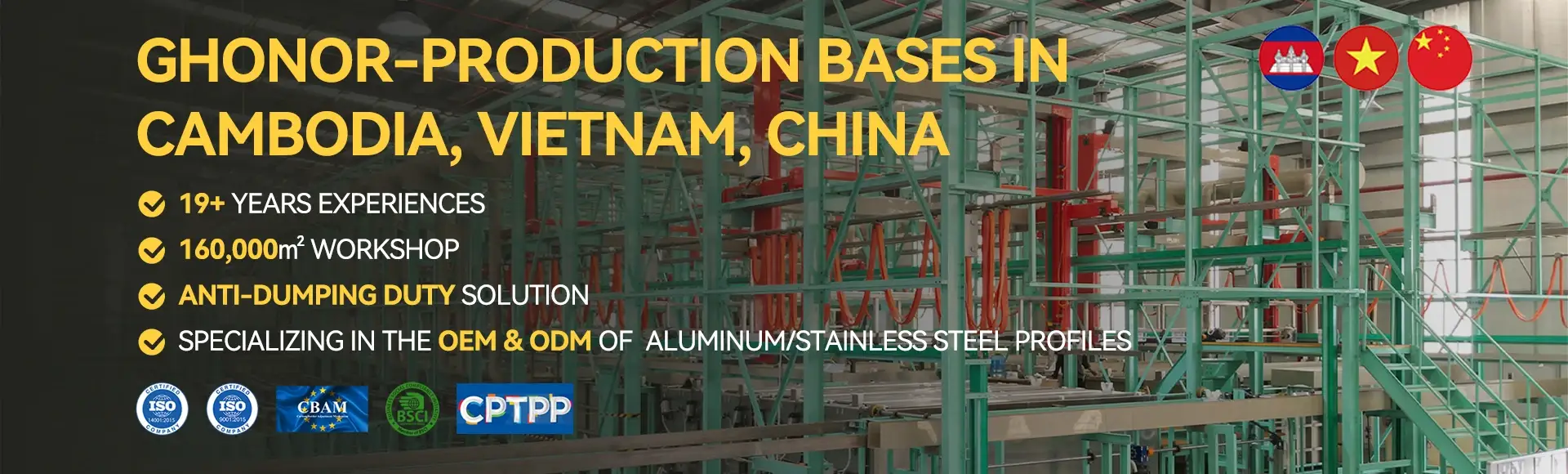
- Cambodia Production Base ( Svay Rieng Province): It will be fully operational in 2026. Our factory in Cambodia can complete the entire manufacturing process of aluminum profiles locally, including extrusion and a 7-meter anodizing production line, as well as automated film protection and labeling equipment. Since all core aluminum processing is completed within the factory, the related goods can obtain genuine and valid Cambodia Origin Certificate (COO).
- Vietnam Production Base (Hung Yen Province): The factory located in Van Lam District, Hung Yen Province, Vietnam. It is our second specialized aluminum product manufacturing center, providing a supply chain redundancy guarantee for American buyers across two Southeast Asian countries.
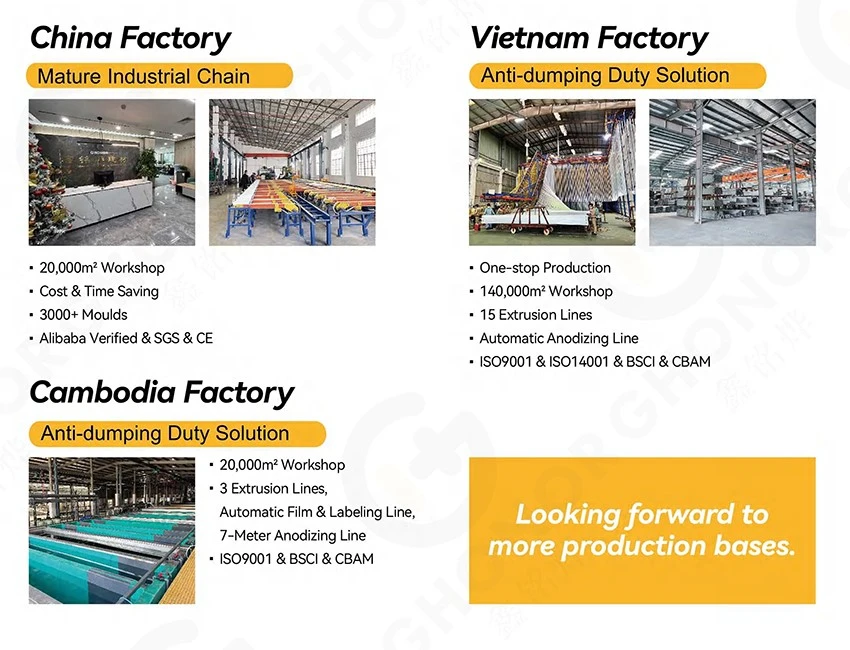
All the stainless steel, brass and PVC tile trims of Ghonor are directly produced at the headquarters in China and then exported. To reduce the overall procurement cost, experienced American importers usually adopt a batch purchasing strategy: they purchase aluminum profiles from factories in Cambodia or Vietnam, and directly order stainless steel, brass and PVC profiles from Chinese factories, thus achieving the lowest compliance import cost throughout the product catalogue.
3. Tariff Engineering: Sourcing Stainless Steel, Brass & PVC Directly from China
While aluminum trims benefit most from Southeast Asian origin, non-aluminum trims follow a completely different tariff logic-and require different manufacturing machinery.
- Leveraging 0% Base Rates on Stainless Steel: For commercial projects, wet rooms, or high-end residential lines, 304 or 316 stainless steel tile trims offer superior durability and frequently fall under US HTS classifications with a 0% MFN base duty (without triggering aluminum AD/CVD orders).
- Cost Control with Brass & PVC: Architectural brass trims offer a premium finish without aluminum anti-dumping exposure, while rigid or co-extruded PVC profiles avoid Section 232 steel and aluminum tariffs altogether.
All of Ghonor's stainless steel, brass, and PVC tile trims are manufactured and exported directly from our China headquarters. Rather than forcing every SKU through one port, experienced US importers routinely split their purchasing strategy-sourcing aluminum profiles from our Cambodia or Vietnam factories while ordering stainless steel, brass, and PVC trims directly from our China factory-to achieve the lowest compliant landed cost across their entire catalog.
4. Do not overlook the customs and border protection (CBP) supply chain and ESG compliance requirements
If containers are detained in Long Beach or Newark due to missing documents, even if the tariffs are 0% or very low rates, it makes no sense. Nowadays, the US customs enforcement agencies attach great importance to supply chain traceability and forced labor screening (such as UFLPA compliance).
When reviewing an overseas tile and decorative piece manufacturer, ensure that its documents are consistent with the factory statement:
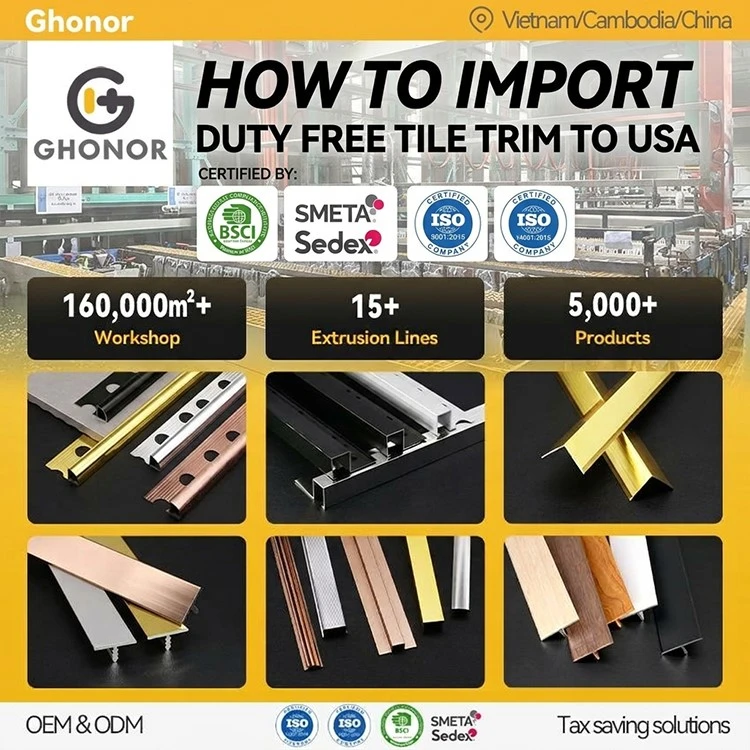
- Social & Ethical Audits: Our facilities maintain BSCI and SMETA (Sedex) certifications, giving US retail chains and wholesale distributors verified proof of compliant labor practices.
- Recycled Content & Environmental Standards: For commercial builds seeking LEED credits or stricter ESG reporting, our RCS 100 (Recycled Claim Standard) and ISO 14001 certifications verify sustainable material sourcing.
- Consistent Multi-Plant Quality: One common worry among US buyers is whether a Cambodia or Vietnam plant can match Chinese factory tolerances. We run unified ISO 9001 quality management systems across all three countries, backed by third-party testing from SGS and TÜV Rheinland, ensuring finish colors and dimensions match batch after batch.
5. Practical Steps Before Placing an Order
If you plan to import ceramic decorative strips to the United States this year, please complete the following quick checklist before finalizing the supplier selection:
- Request factory test reports (MTR) and technical drawings: Before the goods leave the factory, have a certified U.S. customs agent verify the exact 10-digit HTS code, or apply for a CBP ruling.
- Review the actual production capacity of the factory: Request on-site video tours or production records to prove that the products undergo extrusion and anodizing processes in Vietnam or Cambodia. Avoid promising "tax-free" aluminum through middlemen, but lacking verifiable local equipment support.
- Compare comprehensive landed costs: Do not only look at the ex-factory price, but calculate the total cost of FOB price, shipping costs, and applicable tariffs under different origins and material groups.
Do you need a customized freight discount quote for your American market?
Whether you purchase aluminum tile trim from our factories in Cambodia and Vietnam, or directly order stainless steel, brass and PVC profiles from Chinese factories, Ghonor can provide complete origin certificates, rolling mill inspection reports, and wholesale prices directly from the factories.
Please send us your project list or SKU specifications (including materials, surface treatment methods and estimated order quantity), and our team will tailor a quote for you to ensure that each material is matched with its best shipping origin.
Share this post

Leah Liu
Hello there! I am Leah. I have worked in the building materials industry for over 10 years. I want to share my experience here - let us make progress together!