


MOQ for custom-colored aluminum corner Trims?
1) Standard colors & MOQs for aluminum corner trims
Ghonor ordering benchmarks:
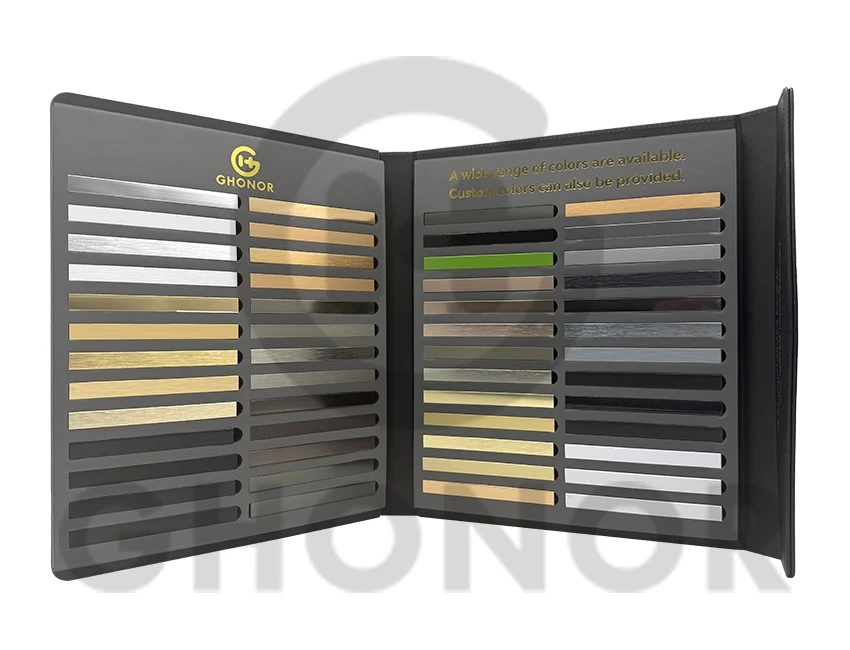
- Use Ghonor's in-stock colors: MOQ = 1,000 pcs per color per model.
Best when you need speed + predictable color repeatability. Ideal for common whites, silvers, champagnes, blacks, etc.
- Custom powder-coated solid color: MOQ = 2 tons per color.
Reason: color development, powder procurement in bulk, line setup, and cure validation all have fixed costs that scale better at tonnage level.

- Custom powder-coated woodgrain: MOQ = 3,000 pcs per color per model.
Reason: wood-effect requires an extra transfer/film step after base coat; artwork/film and line time push the economic lot size higher.

- Custom anodized color: MOQ = 2–4 tons (depends on color difficulty).
Reason: new color requires adjusting/qualifying the anodizing (coloring & sealing) tanks-bath chemistry, electrolyte, and color stability must be tuned and proven, which is only economical at tonnage scale.

Tip: If your volumes are below these thresholds, consider (a) choosing from Ghonor's stock palette, or (b) batching multiple models into the same tonnage color run to meet the custom thresholds with one color.
2) How anodizing works-and why custom anodized colors need 2–4 tons
What it is. Anodizing is an electrochemical process: the aluminum profile becomes the anode in an acid electrolyte, building a hard, porous aluminum-oxide layer that's grown from the metal itself (not a paint that sits on top). After anodizing, the porous oxide is colored (dye or electrolytic) and then sealed to lock in color and corrosion resistance.
Architectural thickness. Architectural anodizing typically targets 10–25 µm (Class II ≈ 10 µm; Class I ≥ 18 µm) to withstand exterior exposure for years.
Why the higher MOQ for custom colors?
- Bath chemistry & stability. To hit a specific bronze/black/champagne tone, the electrolytic coloring bath (often tin-salt based) must be set up, stabilized, and proven; this is most economical at tonnage scale.
- Tank utilization. Anodizing tanks are large. Changing color families implies changing and re-qualifying baths and sealing parameters-a fixed cost best amortized over 2–4 tons of output. (That 2–4-ton band is why Ghonor quotes a range depending on color difficulty and tank strategy.)
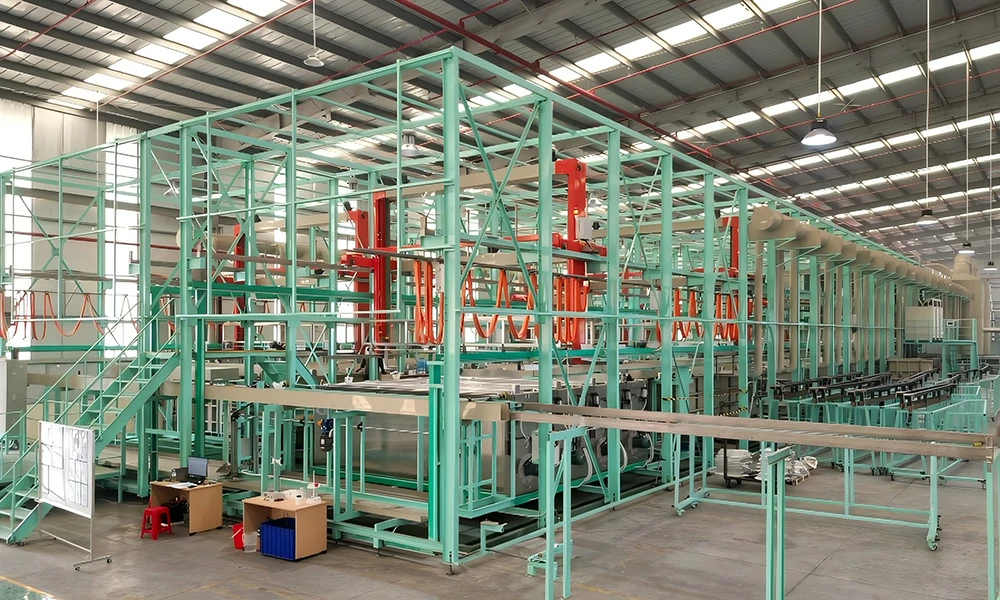
- Line reality. Ghonor partners with fully automated anodizing lines (see Sunward's automation examples) that prioritize long, consistent runs for color uniformity and repeatability.
Process snapshot (automated line): cleaning/degreasing → etch/desmut → anodize (sulfuric) → color (dye/electrolytic) → seal. Automated controls maintain temperature, current density, and chemistry for consistent film growth and color.
3) How powder coating works-and why custom solid colors need ~2 tonsDescription
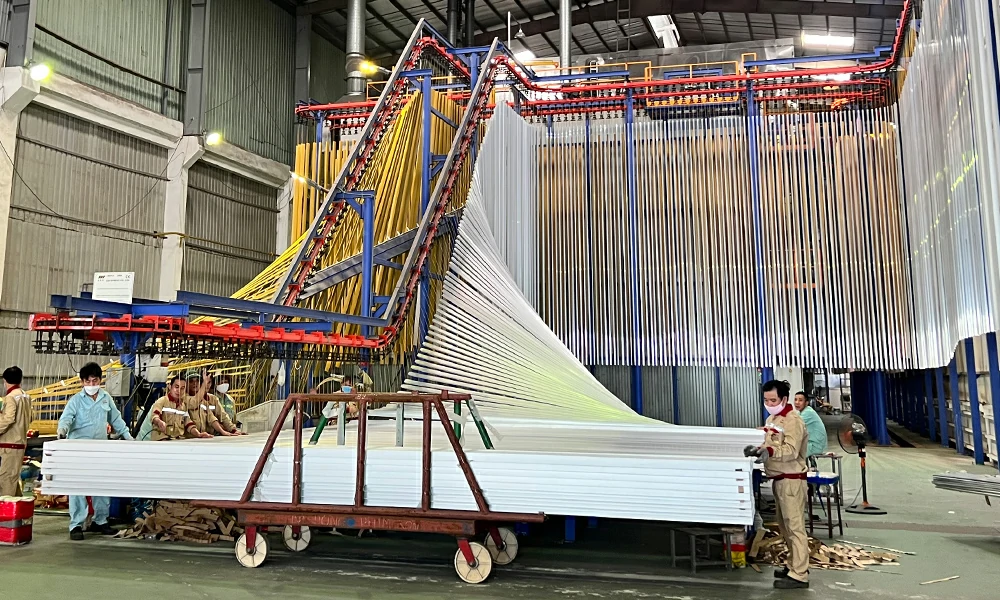
What it is. Powder coating uses electrostatic spray deposition (ESD) to charge dry powder that's attracted to the grounded aluminum profile. After spraying, parts are oven-cured to crosslink the resin into a tough, continuous film. Typical architectural thickness is ~50–120 µm.
Why ~2 tons per new solid color?
- Powder procurement & lot control. Custom colors require minimum manufacturing lots from the powder supplier to ensure color consistency across the job; coil and batch qualification add setup cost.
- Line setup & cure validation. Switching colors burns line time for purge, gun cleanout, and oven cure verification. Economically, a fresh color is justified at tonnage scale.
- Throughput reality. High-capacity automated coating lines (example capability: 2 vertical + 2 horizontal lines; 7 m lengths) are optimized for longer, single-color campaigns-again, favoring tonnage MOQs.
Woodgrain exception (3,000 pcs). Wood-effect requires a base powder + film transfer (or sublimation) step-extra tooling and line passes increase the piece-count MOQ.
4) How to choose colors smartly (and avoid over-MOQ)
- Check Ghonor's stock palette first. If a close match exists, 1,000 pcs per color per model keeps your inventory and cash flow lean.
- Think in families. If you must go custom, pick a hue that multiple models (e.g., L-trim, square trim, end caps) can share in one run to hit 2 tons efficiently.
- Mind outdoor heat & LRV. Dark colors absorb heat; higher LRV shades stay cooler and reduce thermal movement and finish stress-especially outdoors. Dulux Powder Coatingsfosroc.com.au
- Application fit:
High-traffic edges / abrasion: consider anodized bronze/black or harder powders. RMC Anodising - Experts in Anodising
Harsh UV/coastal: both architectural anodize (Class I) and high-grade architectural powders perform well-spec to recognized standards. Linetecunionfab.com
- Sample + approve. Always confirm color samples (chips & short profiles) under the project's lighting before releasing full production.
5) Powder-Coated vs. Anodized Aluminum Trims
| Aspect | Powder-Coated Aluminum Trim | Anodized Aluminum Trim |
|---|---|---|
| What it is | Thermoset polymer film sprayed by ESD, then cured. | Electrochemically grown aluminum-oxide layer (part of the metal). |
| Typical thickness | ~50–120 µm (2–5 mils). msmetal.co.ukgz-supplies.comShengen Sheet Metal | Architectural ~10–25 µm (Class II ≈ 10 µm; Class I ≥ 18 µm). LinetecRMC Anodising - Experts in Anodising |
| Color range | Very wide (RAL/Pantone matches, textures, metallics; woodgrain via transfer). | Natural metallic look; dyed/electrolytic bronzes/blacks/champagnes; superb colorfastness with proper sealing. aluminium-guide.commembers.anodizing.org |
| Surface feel | Can be matte to high-gloss; can hide small substrate marks. | Crisp metallic sheen; highlights substrate quality. |
| Corrosion/UV | Excellent with right pre-treatment (e.g., phosphating) & architectural-grade powders. powdercoating.org | Excellent-oxide is integral; sealing is critical for long-term weathering. anodizing.org |
| Impact/abrasion | Very good; thickness helps chip resistance; touch-up is possible. | Very hard, wear-resistant surface; scratches reveal metal color beneath. |
| MOQ (Ghonor) | Stock color: 1,000 pcs/color/model. Custom solid: 2 tons/color. Woodgrain: 3,000 pcs/color/model. | Custom anodized color: 2–4 tons (depends on color difficulty & bath). |
| When to choose | Exact brand colors, textures, or wood effects; broad design freedom. | Premium metallic look, tight tolerances, high wear/UV stability; long exterior life. |
| Line/Partner example | High-capacity automated powder lines up to 7 m profiles. sunward-alu.com | Automated anodizing tanks with controlled chemistry & sealing. sunward-alu.com |
6) Summary (how to spec fast-and hit MOQs without waste)
- Fastest path: choose from Ghonor's stock colors → 1,000 pcs/color/model MOQ.
- Brand-exact solids: plan for powder custom at ~2 tons/color; batch models to reach tonnage; pre-approve color chips.
- Wood effect: expect 3,000 pcs/color/model due to the transfer step.
- Premium metallics / exterior longevity: consider anodized colors; budget 2–4 tons for new colors because tanks & baths must be set, stabilized, and sealed for consistent results.
- Design smart: use higher-LRV tones outdoors to reduce heat load; specify recognized thickness ranges (powder ~50–120 µm; anodize 10–25 µm) and follow best-practice pretreatment/sealing.
Share this post

Leah Liu
Hello there! I am Leah. I have worked in the building materials industry for over 10 years. I want to share my experience here - let us make progress together!