


What is the difference between aluminum pipe and aluminum tube?
What's the Difference Between Aluminum Pipe and Aluminum Tube? (Buyer's Guide + Pro Tips)
If you've ever opened a drawing that says "1.5 in tube" on one page and "1.5 in pipe" on another, you know how quickly quotes, cuts, and fittings can go sideways. Here's the plain-English breakdown-what each term really means, how they're sized, where they're used, and how to spec them correctly. Along the way, we'll show how Ghonor's China + Vietnam manufacturing can customize either option with production-grade documentation and, when needed, duty-smart origin.

Quick answer
- Function: In industry shorthand, pipe is primarily for moving fluids/gases (pressure-rated). Tube is primarily structural/mechanical (frames, posts, machine guards).
- Sizing system: Pipe is specified by NPS (Nominal Pipe Size) plus a Schedule for wall thickness-ID varies with schedule. Tube is specified by OD and wall (or OD + ID) to actual, "true" dimensions.
- Shapes: Pipe is round only; tube can be round, square, rectangular (RHS/SHS).
- Tolerances: Tube typically holds tighter dimensional/form tolerances than pipe (part of why it's preferred for precision/structural builds).
- Standards: Aluminum pipe and seamless extruded tube for pressure service are covered by ASTM B241/B241M; general extruded aluminum profiles/tubes also reference ASTM B221.
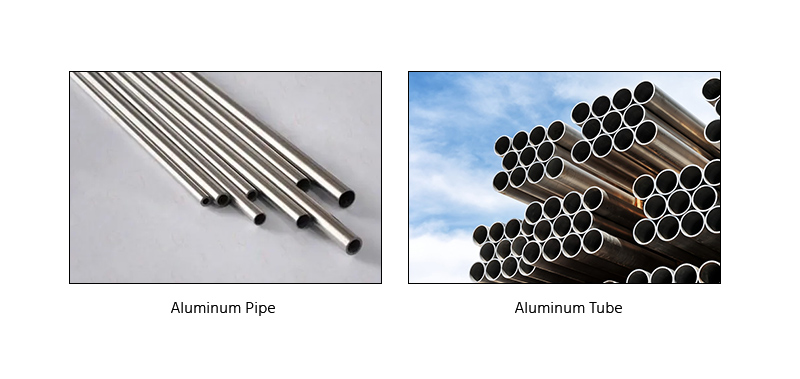
Pipe vs. Tube, side by side
|
Topic |
Aluminum Pipe |
Aluminum Tube |
|
Primary intent |
Convey fluids/gases with a pressure rating |
Structural/mechanical members, frames, posts |
|
How it's measured |
NPS + Schedule (ID capacity + wall) |
OD + Wall (or OD + ID) – true size |
|
Shapes |
Round only |
Round, square, rectangular (RHS/SHS) |
|
Typical tolerances |
Moderate |
Tighter (OD, wall, straightness/ovality) |
|
Typical alloys |
6061-T6 for strength; 6063 for finish (varies by use) |
6063-T5/T6 for architectural surface; 6061-T6 for higher loads |
|
Common specs |
ASTM B241/B241M (seamless pipe; seamless extruded tube) |
ASTM B221 (extruded profiles/tubes); B241 for pressure-type tubes |
Why the confusion happens: many projects use both-e.g., Schedule 40 aluminum pipe for handrails (round fittings ecosystem), and square/rectangular tube for the frame beneath. Sizing vocabulary shifts with the purpose and the hardware you attach.
How the sizing systems actually work
Pipe (NPS/Schedule): For a given NPS, OD is fixed; increasing the Schedule thickens the wall and shrinks the ID (affecting flow). That's why you must specify both NPS and Schedule on RFQs.
Tube (OD/Wall): You call out OD and wall (or OD + ID). Dimensions are "as listed," which is why tube nests/telescopes predictable and is preferred where fit-up and aesthetics matter.
Pro tip: if your drawing says "1-1/2"" without context, confirm whether the engineer meant NPS (pipe) or actual OD (tube) before you cut or quote. It saves rework and returns.
Which one is suitable for you
- Choose pipe when you're carrying fluids or compressed air and need a pressure-rated ecosystem (valves, flanges, threaded or welded connections). Commonly round, schedule-based.
- Choose tube when you need stiffness/strength-to-weight, clean corners/sightlines, or tight tolerances-machine frames, balustrades, retail fixtures, architectural members, enclosures. Shapes include RHS/SHS/CHS.
Tolerances & finish (why tube often looks "straighter")
By convention and standard practice, tubing is ordered to tighter tolerances (OD/ID/wall/straightness/ovality) than pipe. That precision makes tube easier to telescopically fit, fixture, and panel-mount-and it's one reason tube is favored in visible installations.
Finishes (for both):
- Anodized (clear/black/bronze/gold; matte/satin) for hard, corrosion-resistant, color-stable surfaces.

- Powder-coated (RAL/custom) when you need thicker film or brand colors.
Round pipe is often left mill or anodized; architectural tubes frequently get color-matched anodize or powder. (Finish selection ties back to environment and brand look.)

How the sizing systems actually work
- Pipe (NPS/Schedule): For a given NPS, OD is fixed; increasing the Schedule thickens the wall and shrinks the ID (affecting flow). That's why you must specify both NPS and Schedule on RFQs.
- Tube (OD/Wall): You call out OD and wall (or OD + ID). Dimensions are "as listed," which is why tube nests/telescopes are predictable and is preferred where fit-up and aesthetics matter.
Pro tip: if your drawing says "1-1/2"" without context, confirm whether the engineer meant NPS (pipe) or actual OD (tube) before you cut or quote. It saves rework and returns.

How Ghonor helps (custom, documented, duty-smart)
- Two-site manufacturing: China (fast, flexible for Asia/Africa/Middle East programs) and Vietnam (integrated extrusion + anodizing/powder + fabrication + kitting) for genuine Vietnam origin-useful when buyers in the U.S./EU/AU/MX/CA need to manage anti-dumping exposure. Recent public notices confirm no U.S. anti-dumping order on aluminum extrusions from Vietnam (subject to change-always confirm current rules).
- Engineering & R&D: DFM on OD/ID/wall/ovality/straightness, custom corner radii, hole/punch patterns, telescoping fits, and fixture-controlled cutting.
- Assortment support: We can kit pipe-ecosystem parts (e.g., Schedule 40 handrail pipe) and architectural tubes (RHS/SHS/CHS), color-matched to your brand.

Share this post

Leah Liu
Hello there! I am Leah. I have worked in the building materials industry for over 10 years. I want to share my experience here - let us make progress together!