

Hey there, everyone! If you're in the commercial flooring game-whether you're a facility manager, general contractor, or even a small business owner renovating a retail space or office-you've probably spent way too many late nights stressing over those tiny, critical details that make a space look polished and hold up to daily wear. One question I get ALL the time from clients is: Can aluminum floor carpet trim actually work with commercial carpet? Spoiler alert: It's not just a "yes or no" answer. There's a whole lot that goes into why this combo is actually one of the most underrated workhorses in commercial flooring, especially from someone who's been in the aluminum floor carpet trim supplier game for over a decade. Let's break this down like we're chatting over coffee (no boring jargon, promise).
First off, let's get one thing straight: commercial carpet isn't your grandma's living room carpet. It's built for punishment-foot traffic, rolling office chairs, spills, you name it. So whatever trim you pair with it needs to step up, not just look pretty. I've seen people try using residential trim for commercial spaces, and it's like putting a toy car tire on a semi-truck-doomed to fail. Aluminum, specifically, is the ideal material here because it's lightweight but way sturdier than plastic or rubber trims. It resists dents from heavy equipment, doesn't fade under fluorescent lights (huge for retail and office spaces), and holds up against moisture from cleaning products, which is non-negotiable in commercial settings.
Wait, but let's talk specifically about aluminum floor carpet trim-what makes it different from other metal trims, and why it pairs so well with commercial carpet. Unlike, say, brass trim that scratches easily or steel that's way too heavy (and prone to rust if not coated right), aluminum has a natural oxide layer that protects it, so it's low-maintenance, which is key for commercial spaces that can't afford constant repairs. I'll often point clients to our Aluminum Floor Carpet Trim page because it's designed specifically to cover the raw edge of commercial carpet, which tends to be thicker and more tightly woven than residential. That means it secures the carpet edge tight, so it doesn't fray over time-something that's a huge pet peeve for facility managers dealing with high foot traffic.

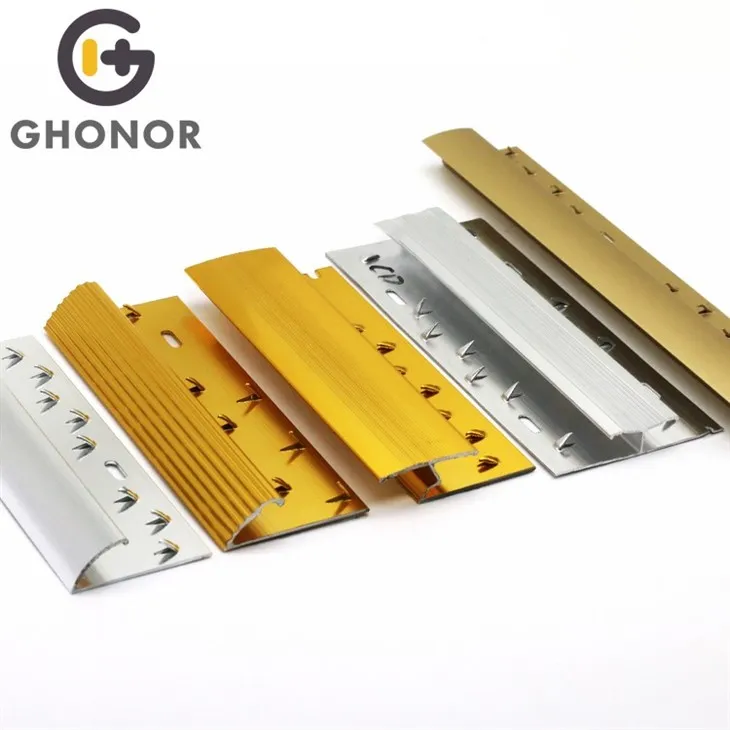
Let's get into the practical side of this. Commercial spaces have specific needs: transitions between carpet and tile, carpet and wood, or even just finishing a run of carpet along a wall or doorway. Aluminum floor carpet trim works here because it's versatile-we make it in different widths and heights to match commercial carpet pile heights (which are usually higher and denser than residential). For example, a commercial carpet for a retail store might have a ½-inch pile, so you need a trim that's ½-inch tall to cover the edge neatly, not too short that it leaves carpet exposed, not too tall that it looks bulky. One client of mine ran a 10,000-square-foot office space with mixed carpet and tile areas; using our aluminum floor carpet trim meant they never had to fix frayed carpet edges, even after 5 years of daily use. They saved thousands on maintenance costs alone.
But wait, is there a catch? Let's be real-nothing's perfect. Some people might worry that aluminum is too slippery, but if you install the trim correctly (with the right adhesive, which we always recommend specifying for commercial use), the top surface is smooth but not treacherous. For areas with heavy foot traffic or where people might carry items, a non-slip top coat is an option we offer, so that's a non-issue. Another thing: if you're using commercial carpet with a heat-bonded edge (common in high-traffic areas), our Aluminum Carpet Edge Trim has a channel that fits that edge perfectly, so there's no gap. Gaps are bad for commercial spaces-they collect dirt, are a tripping hazard, and make the whole floor look messy.
Let's also compare aluminum floor carpet trim to other transition strips, because that's where people get confused. A lot of folks mix up Aluminum Carpet Transition Strip with the floor carpet trim, but transition strips are for moving between two different flooring types (like carpet to tile), while the floor carpet trim is for finishing the edge of a single carpet run. If you're transitioning, the Aluminium Carpet Edge Strip is another great option-we get inquiries about that all the time because it's slimmer, which works for more modern commercial spaces where you want a cleaner look. But for covering the raw edge of the carpet itself, aluminum floor carpet trim is your best bet, especially because commercial carpet edges can be much more rigid than residential ones.
Another big plus for commercial use: aluminum is 100% recyclable, which is a huge selling point for businesses that are trying to meet sustainability goals (more and more of them are these days). We've had a lot of eco-focused clients choose our aluminum trim over plastic alternatives because it aligns with their green initiatives, without sacrificing durability. And since aluminum doesn't off-gas (unlike some cheap vinyl trims), it's safe for indoor air quality in offices and retail spaces, which is a big deal for health-conscious businesses.
Wait, let's talk installation-because even the best trim won't work if it's installed wrong. For commercial carpet, you can't just use double-sided tape (that's for a bedroom, not a mall). You need to use a heavy-duty commercial adhesive, and make sure the trim is secured tightly to the subfloor, not just the carpet edge. Our team always gives clients step-by-step guides for installing aluminum floor carpet trim, and we even offer custom cutting services to make sure the trim fits exactly, no rough edges or gaps. I once had a client try to install a cheaper trim from a big-box store for a restaurant renovation, and it popped off in 2 months because the adhesive wasn't strong enough for the kitchen's high moisture and foot traffic. Switched to our aluminum floor carpet trim, and it's still holding strong 3 years later.
Is there a scenario where aluminum floor carpet trim isn't the right choice? Maybe if you're going for a super rustic, industrial look with exposed concrete floors, but even then, we make aluminum trim with a brushed finish that complements that vibe. Or if you're working with a very thin commercial carpet, but we have trim options with smaller heights to match that. It's all about matching the trim to the specific commercial carpet's specs and the space's needs.
Let me share a quick real-world example to drive this home. Last year, we worked with a local hospital that was renovating their patient wing. They needed something that could handle constant foot traffic from nurses, visitors, and medical equipment, resist spills from cleaning supplies, and be easy to sanitize. They were initially using plastic trim, but it cracked within 6 months. Switched to our aluminum floor carpet trim, paired with Z Strip Carpet Transition for transitions between carpet and vinyl in the hallways. The trim has been going strong for 18 months, no cracks, no frayed carpet edges, and the hospital's maintenance team says it's way easier to clean-just wipe it down with a disinfectant, no scrubbing required. That's exactly what commercial spaces need: durability, ease of maintenance, and a professional look that doesn't break the bank.
Now, I know what some of you are thinking: "Aluminum trim might be expensive upfront, but what about long-term costs?" Let's do a quick math check. A commercial plastic trim might cost $2 per linear foot, but it needs to be replaced every 1-2 years due to cracking, fraying, or wear. Our aluminum floor carpet trim is $5 per linear foot, but it lasts 10+ years. Over a 10,000-square-foot space, that's like $20,000 vs. $100,000 in replacement costs. That's not a small difference-especially for small businesses or tight commercial budgets. It's an investment, but it pays off in the long run.
So, to circle back to the original question: Can aluminum floor carpet trim be used with commercial carpet? Absolutely-not only that, it's one of the most reliable, cost-effective, and low-maintenance options on the market for commercial spaces. It's durable, versatile, fits the specific needs of thick, high-traffic commercial carpet, and can be customized to match your space's style.
If you're in the middle of a commercial flooring project and want to make sure you get the right trim for your commercial carpet, don't overcomplicate it. We've worked with hundreds of commercial clients, from retail stores to hospitals to office parks, and we can help you pick the perfect aluminum trim-whether that's our main aluminum floor carpet trim, or a transition strip or edge strip depending on your needs. Just reach out to our team to chat through your project details, we're here to help you avoid the headaches of bad trim and get a finished space that looks great and holds up for years.
References
- Commercial Flooring Trends 2024, National Institute of Building Sciences
- Material Durability Testing for Commercial Interior Surfaces, American Society for Testing and Materials (ASTM)
- Sustainability in Commercial Construction, U.S. Green Building Council (USGBC)
- Installation Guidelines for Metal Transition Strips, Floor Covering Installation Contractors Association (FCICA)