


Aluminum T-Molding vs. Wood Transition Strips: Real-World Durability & Service Life Compared
If you ask a floor installer or commercial contractor about transition strips, they will likely give the same answer: since transition strips are usually the first part to fail on floors, choose them carefully.
When connecting two rooms, choosing between aluminum T-molding and traditional wooden strips later affects maintenance and repair work.

So, which one lasts longer?
In fact, a aluminum T-molding can last 15 to 20 years or even longer, and it can last longer than the floor itself. Solid wood or medium-density board (MDF) typically exhibits severe wear, deformation, or cracking within 3~5 years, especially around door frames, kitchen areas, and often crowded hallways.
Thanks to modern printing thermal transfer technology, the surface of aluminium profiles can now be created to wood patterns by means of heat transfer, eliminating the aesthetic compromise between metal and wood.
Why Wood Transition Strips Fail Early in Real Installations
Wood matching profiles look great on day one. But wood is an organic material, and its structural limitations quickly surface under everyday abuse.

1. Water Exposure and Subfloor Moisture
The transition strips are located at the joint areas between different rooms, such as between the tiled kitchen and the laminate floor living room. Whenever the floor is mopped or wet shoes step on it, the ends of the wooden strips will absorb moisture.
- The medium-density fiberboard (MDF) / laminate floor strips will expand like a sponge when they absorb moisture, causing delamination and detachment.
- The solid wood strips are prone to bulging, warping, and eventually lifting and detaching from the track due to uneven expansion.
2. Edge Splintering from Point Loads
Think about what a T-shaped formwork would encounter every day: narrow high-heeled shoes, heavy luggage wheels, vacuum cleaners, and moving furniture. Wood has a relatively low shear strength in anisotropic directions. Under repeated impacts, the small cantilever parts of the wooden T-shaped formwork will directly fracture or split along the grain lines.
3. Loose Fasteners and Squeaking
Wooden joints are usually fixed using dowels or plastic wall plugs. Due to the expansion and contraction of wood caused by seasonal humidity changes, the installation holes gradually loosen over time. As a result, a wooden strip that makes a "clicking" sound becomes a tripping hazard.
The Engineering Advantage of Aluminum T-Molding
Extruded aluminum profiles ignore the environmental factors that destroy wood.
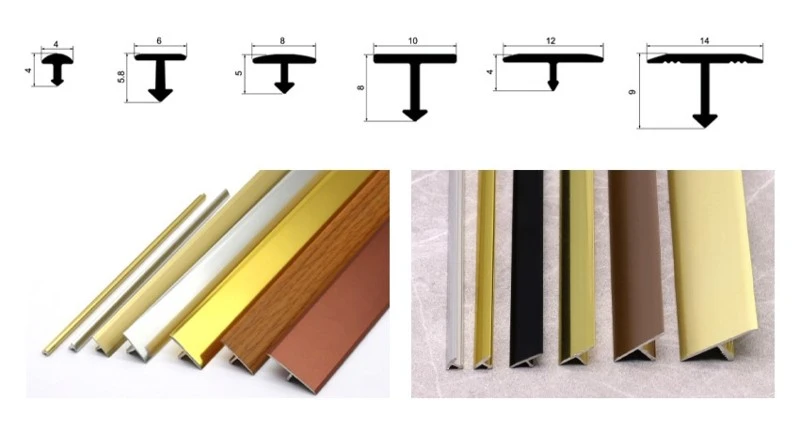
1. Manufactured with 6063-T5 architectural alloy
Commercial-grade aluminum T-profiles are not made from soft steel plates but are formed by extrusion using 6063-T5 annealed aluminum. This alloy achieves an ideal balance between tensile strength and yield toughness, ensuring that it will not crush even when subjected to rolling loads, drop impacts, or large numbers of commercial foot traffic.
2. Zero moisture absorption
Aluminum is completely waterproof and can be used for long-term immersion in water without any size changes exceeding the millimeter level. This makes it the only reliable choice for entering damp areas such as bathrooms, kitchens, and basements.
3. Snap-In Metal Sub-Tracks
Professional aluminum T-profiles are not directly fixed with visible surface screws but use hidden aluminum bases or hard PVC base rails that are anchored below the ground. The top of the T-profiles can be tightly inserted into the rails, firmly fixing the floor edges, while leaving necessary expansion gaps to accommodate the installation requirements of floating LVT, SPC, or composite flooring.
Thermal Transfer Wood Grain: Ending the Aesthetic Compromise
For years, architects and homeowners picked wood simply because metal looked too "industrial" next to timber floors. Thermal Transfer Wood Grain Printing (Vacuum Sublimation) completely changed that dynamic.
How the Wood Effect is Baked In
- Electrostatic Powder Base: The raw 6063-T5 aluminum profile gets a durable polyurethane powder coat.
- Vacuum Film Wrapping: A HD wood-grain transfer film is wrapped tightly around the profile under a high vacuum seal.
- High-Heat Sublimation: The wrapped profile goes into a curing oven at 190°C to 200°C. At this temperature, the inks convert directly to gas and sink deep into the powder layer-not just onto the surface.
Because the pattern is baked inside the coating, it will not peel or flake like cheap vinyl wraps. It stands up to heavy foot traffic, pets, and UV exposure from patio doors without yellowing.
Material Comparison Breakdown
|
Performance Metric |
Extruded Aluminum T-Molding |
Solid Hardwood Strip |
MDF / Foil-Wrapped Strip |
|
Typical Service Life |
15 – 20+ Years |
3 – 7 Years |
1 – 3 Years |
|
Moisture Resistance |
100% Waterproof |
Poor (Absorbs water, warps) |
Very Poor (Swells and splits) |
|
Impact Tolerance |
Extremely High (6063-T5) |
Medium (Dents and scratches) |
Low (Cracks easily) |
|
Finish Durability |
Sublimated / Anodized |
Varnish wears off in 2 years |
Paper foil peels when wet |
|
Maintenance |
Wipe clean (Zero maintenance) |
Needs sanding & refinishing |
None (Requires replacement) |
|
Ideal For |
High-traffic residential & commercial |
Low-traffic bedrooms only |
Low-budget temporary fixes |
The Real Cost: Initial Price vs. Lifetime Expense
An MDF or cheap timber strip might cost a few dollars less per length at retail. But when you factor in:
- Replacing damaged strips every few years
- The labor cost of pulling up old tracks
- Potential damage to adjoining floor edges when a wood strip breaks
The total cost of wood transitions adds up fast. Specifying aluminum T-moldings once eliminates warranty callbacks for contractors and gives property owners a zero-maintenance solution for decades.
FAQ
Q: Can I cut aluminum T-molding on a job site with standard tools?
A: Yes. You don't need specialized factory machinery. A standard miter saw fitted with a non-ferrous carbide-tipped blade (80 teeth or higher) cuts aluminum profiles cleanly without burrs.
Q: Does wood-grain aluminum scratch easily?
A: No. Because the sublimation process fuses the wood pigment inside a thermosetting powder layer, its scratch resistance is vastly superior to traditional wood lacquer or clear coats.
Q: Will an aluminum T-molding work if my two floors aren't perfectly level?
A: Standard T-moldings are engineered for floors at the same height (0mm offset). If there is a height difference between tile and LVT, use an aluminum reducer profile instead of a T-shape to prevent a lip.
Share this post

Leah Liu
Hello there! I am Leah. I have worked in the building materials industry for over 10 years. I want to share my experience here - let us make progress together!